Canva Productathon (LinkedIn)
Storytelling and moodboard in-app editing features that foster genuine connection and encourage authenticity in the LinkedIn mobile platform.
★ Context
As part of the Canva x Prodigi Productathon challenge, my team of 4 were tasked with selecting a social media mobile app and designing an experience within the in-app editor that could potentially boost interactions and engagement of the platform. As young adults in the beginning stages of our career, we felt that LinkedIn was relevant to the Gen Z demographic as the fastest growing user groups of the platform.
★ Research
Our team set out to discover more about Gen Zs and what they thought of LinkedIn through secondary research, online ethnography and user interviews. After affinity mapping our key findings on Miro, we were able to give life to our persona. We also created a user journey navigating through LinkedIn focusing on the pain points and the emotions she’s feeling during each interaction.
Thus, the "How might we?" statement that emerged was "How might we enable users to feel authentic when sharing content about themselves with other likeminded individuals?"
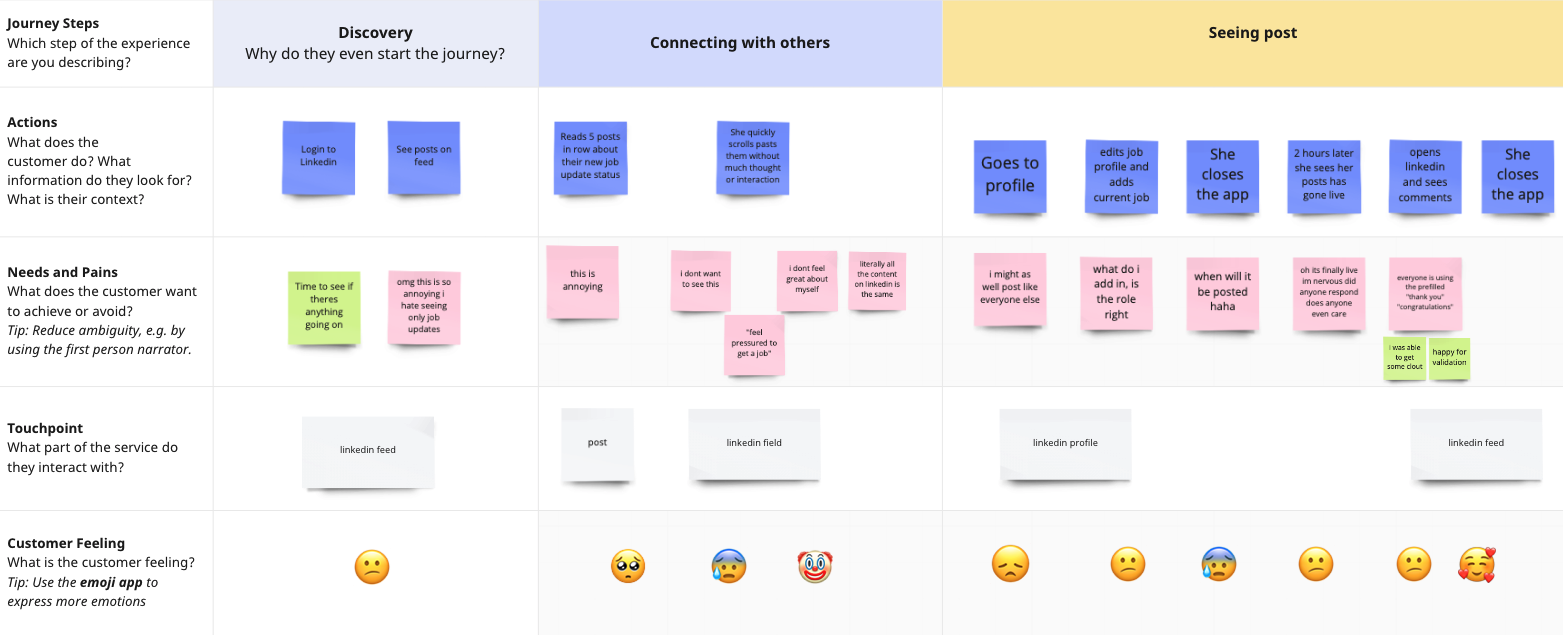

User Journey Map
Interview Questions


User Persona brainstorm
Pain Points
★ Concept
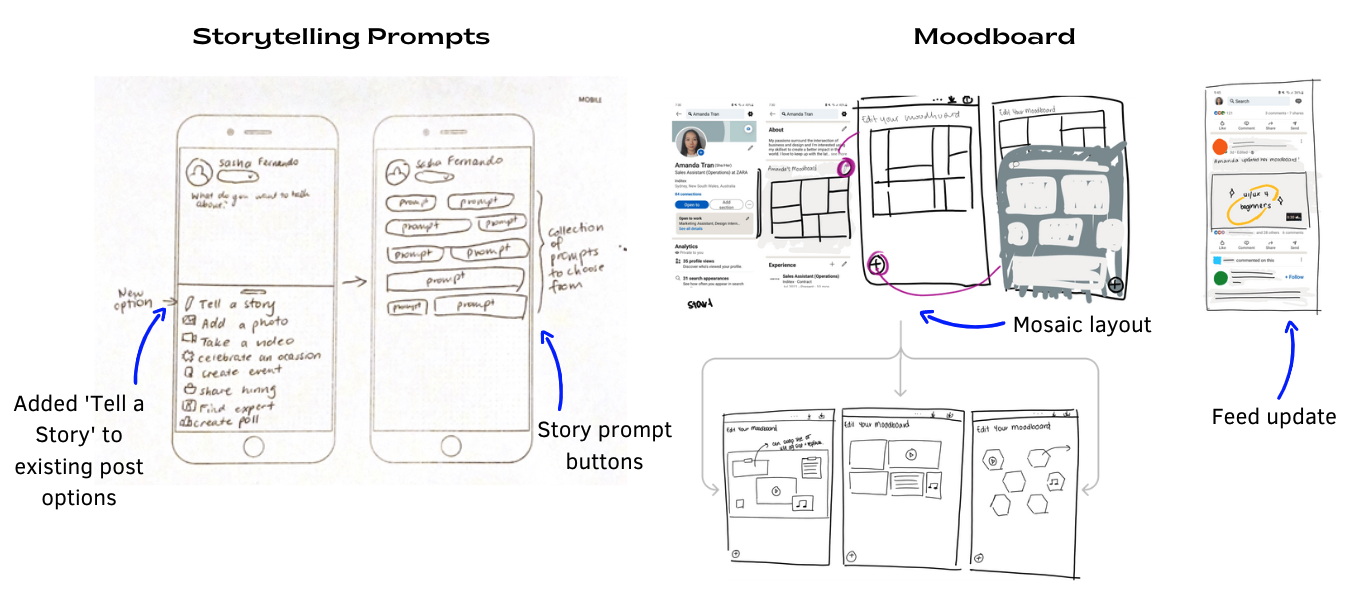
To generate innovative ideas we used the Crazy 8 method, we thought of a high quantity of ideas under time pressure.. Taking things like feasibility and viability into account, we considered two potential solutions. As seen in these sketches, our main solution is a storytelling feature for posts with creative prompts. For future implementation, another potential feature is a personal mood board on your profile to display your career and life ambitions.
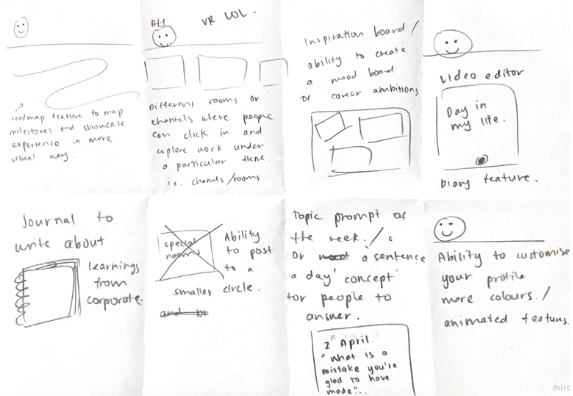
Crazy 8 ideation
Sketches
★ Iteration
After informally critiquing our sketches internally, we added more visual elements like emojis and customizable space, and conducted usability testing. We employed a think-aloud exercise in which participants were given tasks to complete without guidance and were asked to voice their thoughts as they were going through these steps. At the end, they completed a System Usability Scale survey to calculate their overall experience.
From this feedback, we implemented even more changes like adding ‘Add note’ and ‘Add emoji’ to the moodboard, and created an onboarding process due to users feeling that they needed some quick introductory guidance.
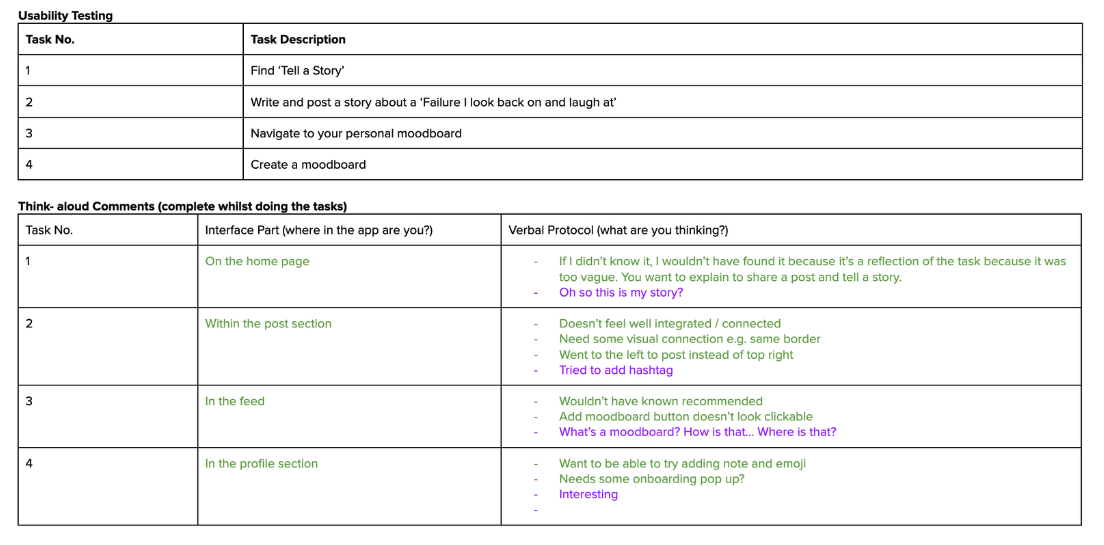

Think-aloud usability testing
System Usability Scale (SUS)
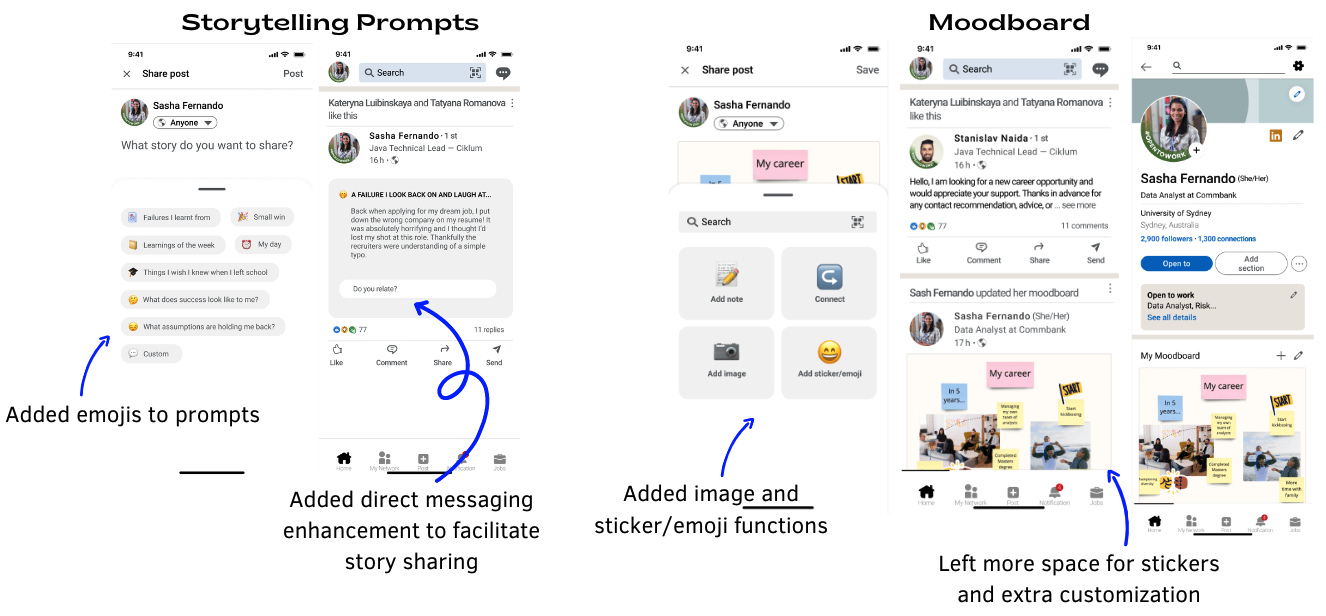
Mid fidelity prototype
★ Final Design
The final solution we have come up with is story prompts aimed to spark genuine, meaningful connection. When Sasha wants to share a personal story she will press the 'Post' icon. Clicking on 'Share your story' will then take her to a list of prompts, in which she chooses one, and types away. Once this is posted, her network will be able to see and people can either comment publicly, or if they're feeling a little shy they can reply directly to the post which would initiate a conversation with Sasha in Messages.
For future implementation in our roadmap we’ve planned to roll out a second feature: moodboards, your very own creative canvas to represent your dreams and aspirations. From your profile, you will be able to create a number of moodboards with different pictures, images, links and videos that inspire or motivate you. Once the moodboard is saved, you have the option to notify your network or just post it on your profile.
★ Next Steps & Learnings
To measure the success of our features, we’ve outlined key measures to validate our solution and the value it will bring to people like Sasha such as adoption rate of these features and qualitative analysis of user satisfaction.
My biggest learning in this project was the importance of shaping the scope appropriately and to ensure the brief is directly being addressed. It can be tempting to begin straying into fixing other features or exploring other issues but the task at hand was to develop a new in-app editor feature, which I feel we did. However, in the future I would concentrate on one feature rather than two. Ultimately, I feel believe that with our solution, people can use LinkedIn comfortably to be their authentic self and create meaningful connections which will help them create a stronger network and career and connect with other similar people.